Notebook | Diary | Lab notes | Resources | Garden | Anapoly
Values, Ethics & Ethos
Transcript of a chat between Alec Fearon and Perplexity AI on 9 August 2025
Alec said
<reference>Colleagues in Anapoly Ltd seek to bridge the gap between mystery or curiosity about AI, and its practical use. We want to help professionals like us apply AI tools to real tasks in a hands-on, transparent way.
<reference>Marjon University is interested in the possibility of a collaboration with Anapoly. The collaboration promises to extend the capability of both organisations for the social good.
<reference>Students are among those most at risk from the misuse of AI.
<reference>There is a risk that students might outsource their thinking to AI and lose or not acquire the ability for critical thinking.
<reference>Anapoly Notebook https://anapoly.co.uk/labs/
<reference> Anapoly Notebook is a website where we document our experiments in the day-to-day use of general-purpose AI. We reflect on what works (and what doesn’t), and share our thinking as it develops
<principle>There is a need to imbue students with values of benefit to society.
<principle>Students need to have an ethos of caring about how the human-AI relationship evolves.
<process>An LLM can be configured to support students to become wiser.
<concept>Anapoly Notebook will have an area in which philosophical ideas can be explored.
<process> Assume Anapoly and Marjon will run a collaborative project. This would be both a substantial piece of work in its own right and a vehicle for applied learning with AI. Purpose: to propose how values and ethos can shape human–AI interaction, using the creation of a substantive long-form essay as both a credible academic contribution and a live, documented case study in the effective, ethical, and collaborative use of AI tools.
<task>Clarify the distinction between “values” and “ethos”.
Perplexity said
Clarifying the Distinction: “Values” vs. “Ethos”
Values
- Values are fundamental beliefs or principles that guide behavior, choices, and judgment.
- They represent what individuals or groups hold as important, worthwhile, or desirable.
- Values are relatively stable over time and can be personal (e.g., honesty, fairness), organisational (e.g., innovation, accountability), or societal (e.g., justice, freedom).
- They often serve as benchmarks for decision-making and evaluating right from wrong.
- Example: In the context of AI, a value might be transparency—the belief that AI systems should be open about their methods and limitations.
Ethos
- Ethos refers to the characteristic spirit, culture, or guiding beliefs of a person, group, organisation, or community.
- It is more than just a collection of values—it is the distinct atmosphere or prevailing philosophy that shapes identity and behavior.
- Ethos is expressed collectively, often through patterns of behavior, shared attitudes, customs, or traditions.
- Ethos provides context—how values are lived out, represented, and fostered within a group.
- Example: An organisation’s ethos might be described as caring and responsible—not just valuing transparency, but actively nurturing a culture where openness and accountability are the norm.
In Practice
- Values are what you believe; ethos is how those beliefs become an embodied, lived reality.
- For a student exploring AI use:
- Values might include integrity (not cheating) and curiosity (desire to learn).
- Ethos would be the flavour of the academic environment—whether it encourages deep, critical engagement with AI tools or merely compliance with rules.
Application to Human–AI Collaboration
- In collaborative AI projects (like between Anapoly and Marjon), values guide what is important (e.g., ethical use, social benefit), while ethos shapes how collaboration feels—whether it is imaginative, respectful, or driven by collective responsibility.
- Imbuing students with “values of benefit to society” means teaching what matters.
- Developing an “ethos of caring” ensures those values shape everyday attitudes and practices, including thoughtful, wise use of AI.
Summary:
- Values: The ideals we prioritise and uphold.
- Ethos: The collective character and lived expression of those ideals within a community.
Both are essential for shaping a thoughtful and socially responsible human–AI relationship.
Alec said
<concept>Anapoly Notebook will have an area acting as a home for the collaborative project referred to earlier in this chat. <task>Suggest five appropriate names / titles for that area
Perplexity said
Certainly! Here are five thoughtful name suggestions for the designated area within Anapoly Notebook that will serve as the home for the collaborative project between Anapoly and Marjon:
- The Collaboration Studio
- AI Ethics & Inquiry Hub
- The Marjon–Anapoly Commons
- The Human–AI Exploration Space
- The Values-in-Action Lab
Each of these titles aims to reflect the project’s spirit of partnership, hands-on experimentation, and the exploration of values and ethos in human–AI interaction. Let me know if you’d like suggestions in a particular style or with a different emphasis!
Alec said
<task>Distinguish “ethics” from “values” and “ethos”
Perplexity said
Ethics vs. Values vs. Ethos
Ethics
- Ethics refers to formal systems or frameworks that define what is right and wrong, usually within a specific context (such as professional, academic, or societal domains).
- Ethics are often codified—set out in rules, guidelines, or codes of conduct. These might be developed by professions, institutions, or societies to guide members’ behavior.
- Ethics involves systematic reflection and reasoning about moral questions—”What should we do?” or “What ought to be done?”
- Example: In higher education, an ethics code might prohibit plagiarism or mandate the fair use of AI in assessment.
Values
- Values are core beliefs or principles held by individuals, groups, or societies that inform preferences and shape behavior.
- Values are internal and subjective—they are about what people care about, such as honesty, creativity, or justice.
- They provide the personal or collective rationale for making choices, but are not necessarily made explicit or written down.
- Example: Valuing honesty might guide a student to acknowledge all sources (including AI tools) in their work.
Ethos
- Ethos is the distinctive spirit, culture, or character of a community, organisation, or environment.
- It emerges from how a group enacts its values—through shared attitudes, customs, and habits, often subconsciously.
- Ethos is experienced as the “atmosphere”—is a place supportive, rigorous, open?
- Example: An organisation may have an ethos of collaborative curiosity, where asking questions and learning together (including with AI) is encouraged.
In Summary
| Term | What is it? | How is it expressed? |
|---|---|---|
| Ethics | Codified frameworks that define right and wrong in a context | Codes, rules, guidelines, systematic reasoning |
| Values | Core beliefs or principles held by individuals or groups | Choices, priorities, what people care about |
| Ethos | Characteristic spirit or culture of a group or organisation | Customs, atmosphere, “the way things are done” |
- Ethics: The rules or principles defining “what’s right.”
- Values: What matters most to us.
- Ethos: The lived spirit, culture, or vibe when we put those values into practice together.
In the context of the Anapoly–Marjon collaboration, having an explicit ethics framework could guide the responsible use of AI, shared values would clarify what truly matters, and a strong ethos would shape a positive, principled learning environment.
Alec said
Is it correct to say that values are embodied in an ethical framework which is put into practice through an ethos?
Perplexity said
Yes — that’s a fair and useful way to put it, though we might nuance it slightly.
Your statement — “values are embodied in an ethical framework which is put into practice through an ethos” — captures the general relationship quite well, but here’s a clearer breakdown:
- Values are the underlying beliefs or principles — the “what matters most.”
- An ethical framework takes those values and organises them into a coherent system of reasoning and guidance for action. This is the step where values start becoming explicit rules, norms, or principles (“How should we act if we care about these values?”).
- Ethos is how those principles and values are lived out in the culture, atmosphere, and everyday behaviour of a group.
So in sequence:
Values → inform → Ethical Framework → expressed and reinforced through → Ethos.
One refinement:
While an ethical framework often embodies values, it can also be influenced by laws, professional standards, or other external factors. Likewise, an ethos can reinforce values even without a formal ethical framework — in some communities, the culture comes first, and formal ethics follow.
If you like, I can create a diagram showing this flow so it’s easy to visualise the relationship. Would you like me to do that?
Alec said
<you said>While an ethical framework often embodies values, it can also be influenced by laws, professional standards, or other external factors. Likewise, an ethos can reinforce values even without a formal ethical framework — in some communities, the culture comes first, and formal ethics follow. <principle>Where culture comes before formal ethics, the culture has an implicit, informal ethical framework <task>Critique that principle
Perplexity said
Your principle — “Where culture comes before formal ethics, the culture has an implicit, informal ethical framework” — is reasonable and often true, but it could benefit from some nuance. Here’s a critique:
Strengths of the Principle
- Recognises ethics beyond codification
- It correctly points out that shared values and norms can exist and guide behaviour even when they’re not written down or formally systematised.
- Many communities rely on “the way things are done” — unwritten rules that still have moral weight.
- Acknowledges cultural primacy
- In some organisations, the ethos and traditions precede any explicit ethics policy, and these traditions act as a de facto framework for behaviour.
- Highlights implicit moral guidance
- Even without a named “code of ethics,” behaviours are often policed indirectly through social approval, disapproval, and cultural expectations.
Possible Limitations
- Implied ethical coherence may be overstated
- A culture can have traditions and norms without them forming a coherent “framework.”
- Some cultures are a blend of contradictory influences, where guidance is situational rather than systematic.
- Risk of bias and exclusion
- An informal framework may simply reflect the dominant group’s values, which may be discriminatory or self-serving rather than universally ethical.
- Formal ethics often emerge to challenge such biases, not just to document existing norms.
- Vulnerability to change or erosion
- Without codification, cultural norms can shift quickly, be misinterpreted, or be lost when leadership or membership changes.
- This fragility means informal ethical systems may lack consistency over time.
- Possible absence of moral reflection
- A culture might be rich in social customs but poor in explicit moral reasoning.
- Informal guidance can drift into habit rather than being grounded in ethically reasoned principles.
Refined version of the principle
You might reframe it as:
“Where culture precedes formal ethics, it usually operates with implicit moral norms, which may function like an informal ethical framework — though not always coherently, inclusively, or consciously.”
This keeps your core insight but acknowledges that informality can mean inconsistency, unexamined biases, and gaps in moral reasoning.
If you’d like, I can map out a diagram showing how informal cultural norms, values, ethics, and ethos relate and evolve over time — which might help Anapoly and Marjon visualise these interdependencies. Would you like me to do that?
Alec said
<task>Tie these ideas together into a explanation which distinguishes values, ethics and ethos whilst recognising culture.
Perplexity said
Alright — let’s weave these strands into a single, coherent explanation that distinguishes values, ethics, and ethos, while recognising the central role of culture.
How Values, Ethics, Ethos, and Culture Connect
At the foundation are values — the beliefs and principles about what is important, desirable, or right. They answer the question: What matters most to us?
- Values may be personal (honesty, curiosity), organisational (innovation, accountability), or societal (justice, equality).
- They are the moral “raw material” from which everything else flows.
Culture is the lived environment shaped by shared history, relationships, language, and traditions. It is how people actually live and work together over time.
- Culture naturally expresses shared values but also shapes them — reinforcing some, downplaying others.
- Culture develops whether or not there is any formal ethical guidance.
- When culture comes first, it carries implicit norms — unwritten but widely understood expectations of behaviour. These can act like an informal ethical framework, but they are not always coherent, inclusive, or consciously examined.
Ethics is where values become explicit, systematic guidance for behaviour.
- An ethical framework takes values (and sometimes external influences like laws and professional standards) and turns them into principles, rules, or reasoning methods.
- Ethics asks: Given our values, how should we act, and why?
- Formal ethics codifies expectations; informal ethics may be embedded in culture without being written down.
Ethos refers to the characteristic spirit or “feel” of a group — the lived expression of values within a culture.
- While ethics defines the rules and reasoning, ethos captures the atmosphere and collective character that emerges when values are embodied in daily life.
- Ethos is tangible in tone, traditions, and shared habits: e.g., a research lab where “integrity and curiosity” aren’t just rules, but felt in how people question, listen, and share.
Putting it Together
- Values are the starting point — our moral compass.
- Ethics is a reasoned map that guides how we apply those values in real situations.
- Culture is the social terrain where these values and ethics live, evolve, and sometimes clash.
- Ethos is the vibe or spirit of that culture when values are actively lived out.
Example (Anapoly–Marjon context):
- Values: Transparency, social responsibility, curiosity.
- Ethics: A joint AI-use policy ensuring clear attribution, fairness, and student agency.
- Culture: A collaborative learning environment where open discussion and experimentation are the norm.
- Ethos: A spirit of “caring curiosity” about AI — you feel it in workshops, discussions, and documentation.
If you’d like, I can express this as a visual model where values feed into ethics, which interacts with culture to shape ethos — and culture also loops back to influence values. This might make the relationship clearer and more memorable.
Do you want me to create that diagram?
Alec said
Yes, let;s see what it looks like
Perplexity said
Alright — here’s a visual model that brings together values, ethics, culture, and ethos, showing how they relate and influence one another.
┌─────────────┐
        │   VALUES    │
        │ "What      │
        │ matters    │
        │ most?"     │
        └─────┬───────┘
              │ informs
              ▼
        ┌─────────────┐
        │   ETHICS    │
        │ "How should │
        │ we act?"    │
        │ (rules,     │
        │ principles) │
        └─────┬───────┘
              │ applied within
              ▼
        ┌─────────────┐
        │   CULTURE   │
        │ Shared      │
        │ norms,      │
        │ traditions, │
        │ behaviours  │
        └─────┬───────┘
              │ lived as
              ▼
        ┌─────────────┐
        │    ETHOS    │
        │ Spirit /    │
        │ atmosphere  │
        │ of the group│
        └─────────────┘
Flow & Feedback Loops
- Values → Ethics: Values inspire the creation of an ethical framework (formal or informal).
- Ethics → Culture: Ethical guidance shapes everyday behaviour and group norms.
- Culture → Ethos: The recurring lived practice produces a shared “feel” or spirit.
- Culture ↔ Values: Over time, cultural experience reinforces or evolves values.
- Ethos ↔ Culture: A group’s spirit motivates how culture operates day-to-day.
💡 Anapoly–Marjon Example
- Values: Curiosity, transparency, care for society.
- Ethics: Agreed rules for fair, open AI use in student projects.
- Culture: Active experimentation, open feedback, respect for diverse perspectives.
- Ethos: A spirit of caring curiosity—you sense it in every discussion and collaboration.
If you’d like, I can also adapt this diagram into a circular model to show the cyclical nature of influence — which might visually suit the idea that culture itself can pre-date formal ethics and reshape values.
Do you want me to prepare that version next?
Alec said
Yes, let’s have a look at that
Perplexity said
Got it — here’s the circular version of the model so you can see how values, ethics, culture, and ethos influence one another in an ongoing cycle rather than a one-way chain.
┌─────────────┐
        │   VALUES    │
        │ "What       │
        │ matters     │
        │ most?"      │
        └─────▲───────┘
              │ shapes
              │
   reinforces │
              ▼
        ┌─────────────┐
        │   ETHICS    │
        │ "How should │
        │ we act?"    │
        │ Rules &     │
        │ principles  │
        └─────▲───────┘
              │ guides
              │
              ▼
        ┌─────────────┐
        │  CULTURE    │
        │ Shared norms│
        │ & practices │
        └─────▲───────┘
              │ lived as
              ▼
        ┌─────────────┐
        │   ETHOS     │
        │ Spirit /    │
        │ atmosphere  │
        └─────┴───────┘
              ▲
              │ influences
              └────────────── back to CULTURE
Why this matters
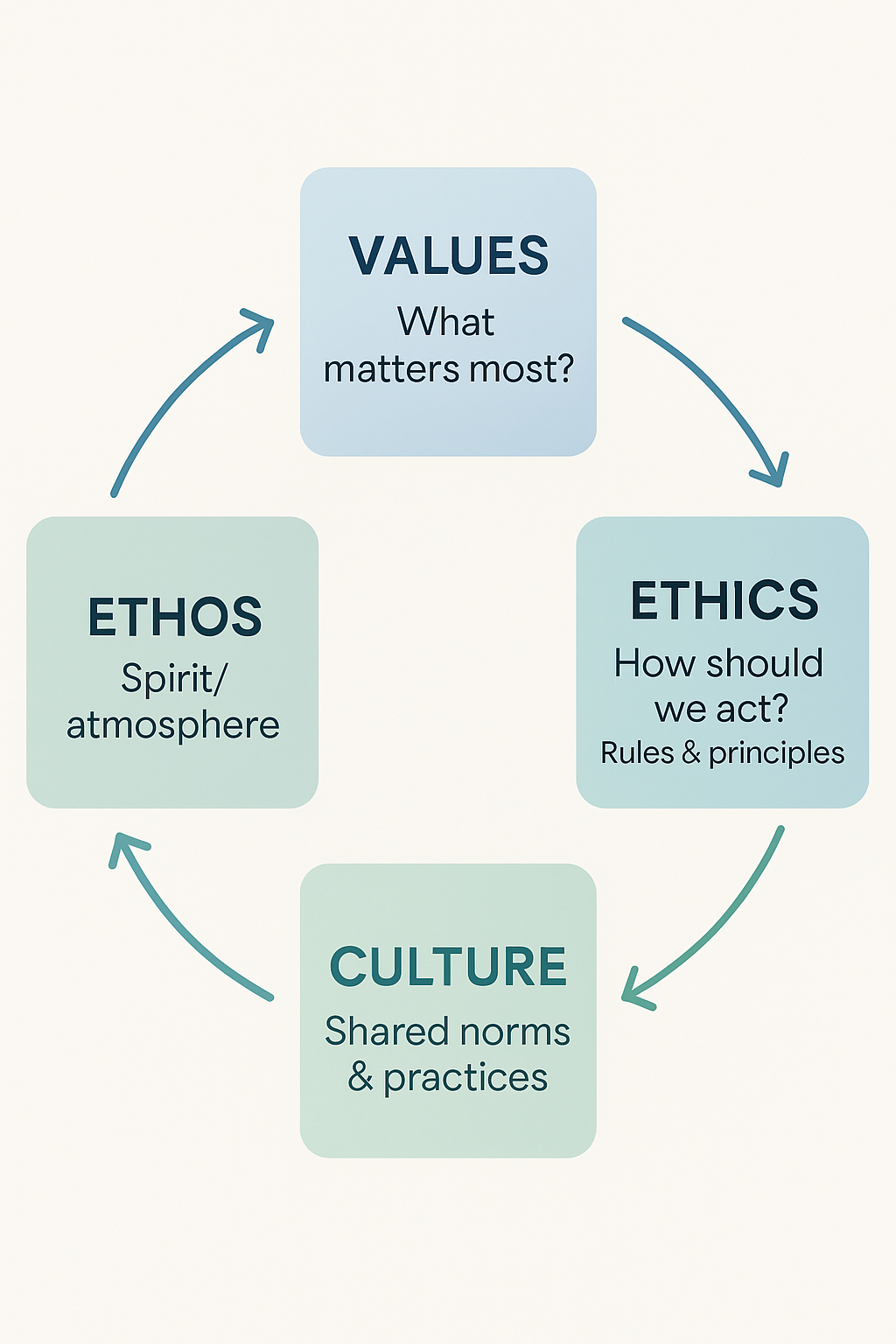
- It’s cyclical, not linear — values lead to ethics; ethics shapes culture; culture generates ethos; ethos reinforces culture; and over time, culture can also reshape values.
- Culture can start the loop — in some communities, shared norms and traditions evolve before any formal ethics are written, creating an implicit moral framework.
- Ethos keeps it alive — without the “feel” of a caring, principled community, ethics risk becoming hollow rules.
💡 Anapoly–Marjon example in this loop
- Values: Curiosity, transparency, social benefit.
- Ethics: Joint principles for fair and open AI use.
- Culture: Workshops, experiments, and discussions that normalise those principles.
- Ethos: A lived spirit of caring curiosity that motivates participation and trust.
…and this spirit feeds back into evolving the shared culture and refining the values.
If you like, I can turn this into a polished infographic with labels and arrows that visually emphasise the feedback loops.
Do you want me to prepare that visual?
Alec said
Yes please, a polished infographic would be useful.
Perplexity said